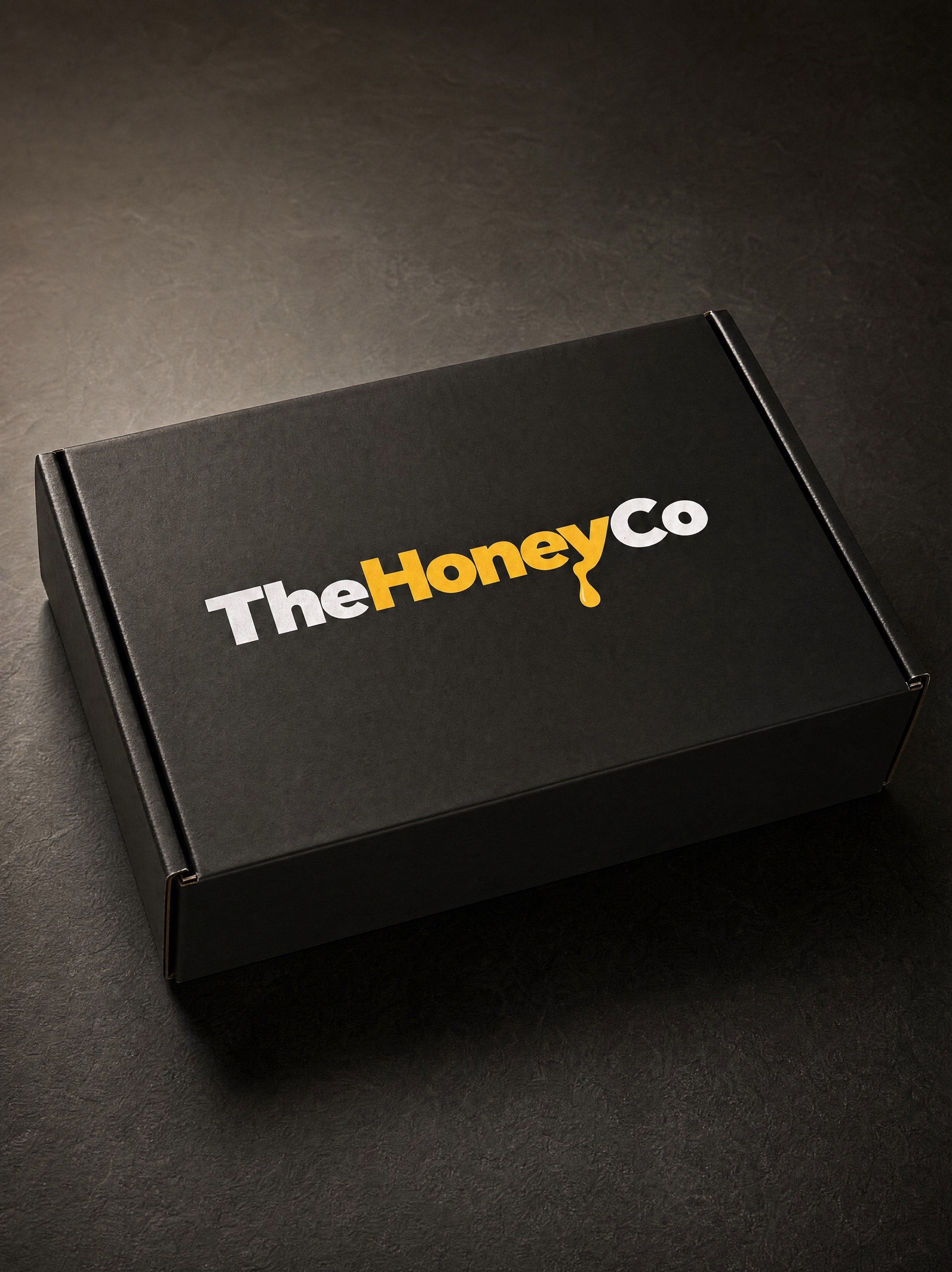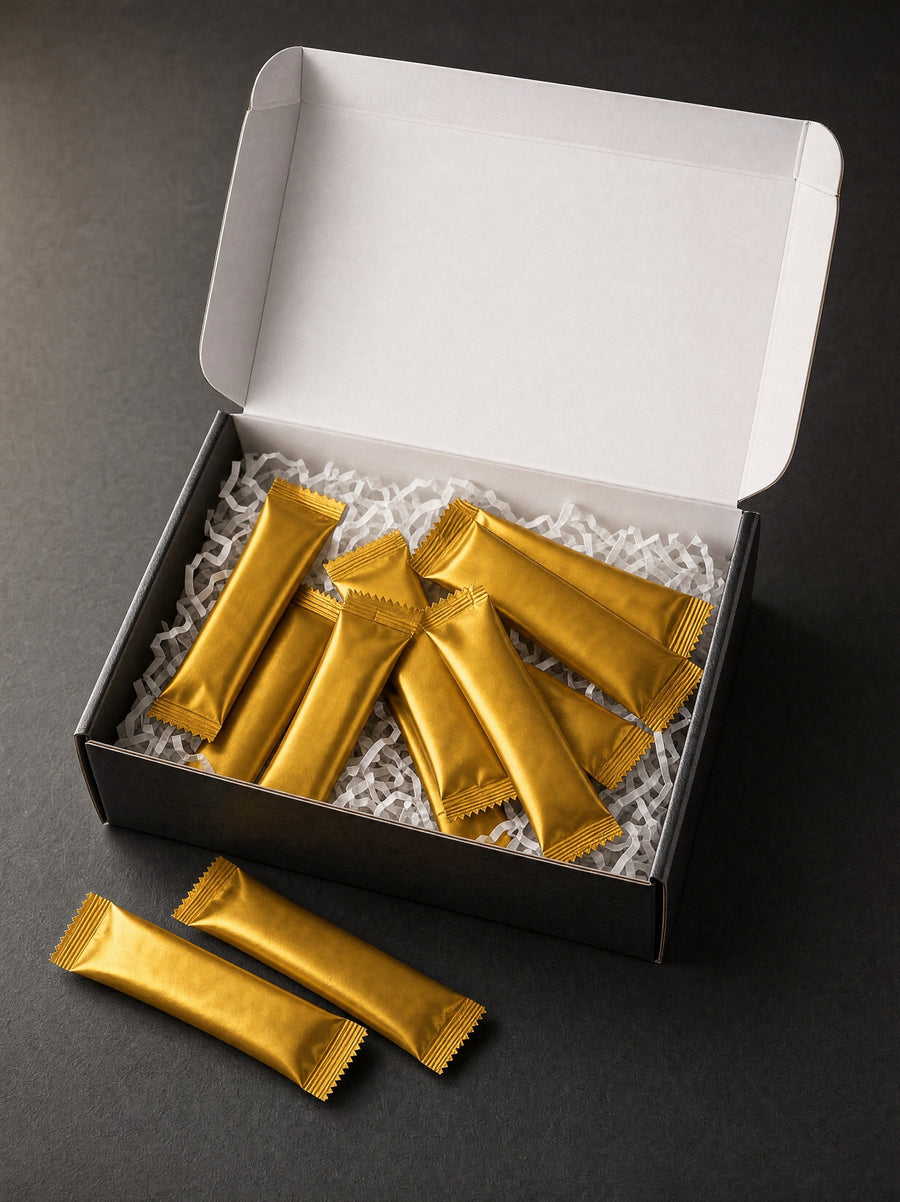
What's a honey pack?
A single sachet of honey with six natural ingredients, honey the main one, every milligram printed on the pack. Tear the top, squeeze it straight in, done.
Not what you're picturing.
Who's it for?Why honey packs get a bad name, and why ours shouldn’t.
Most people who have heard of a honey pack have heard of the imported “royal honey” kind. Regulators keep finding hidden drug ingredients in some of them, never listed on the label [1][2].
We wanted the honey pack done honestly. Six natural ingredients, honey the main one, every milligram printed on the pack, sold as a food.
Sources: [1] US FDA public notification, 2017 [2] US FDA public notification, 2020
It starts with honey.
Honey is the sachet, and the main one of its six natural ingredients. The rest ride in it.

People have gone after honey for a very long time
Chemists who tested more than 6,400 pieces of Stone Age pottery from Anatolia found beeswax in pots about 9,000 years old, the oldest chemical proof of people using bee products [1]. A rock painting at Bicorp in Spain, often dated to about 8,000 years ago, shows a figure on ropes reaching into a wild nest. Egyptian medical papyri, including the Ebers Papyrus from about 1550 BCE, use honey in many of their preparations.
Why honey keeps
Honey is acidic, very low in free water and makes a little hydrogen peroxide. Microbes struggle to grow in it, which is why sealed honey keeps for years [2]. If it thickens in the cold, it’s still fine: warm the sachet in your hand for a minute.
Food energy
Honey is about 80% carbohydrate, mostly fructose and glucose. Sports scientists have tested it as fuel: a review of nine studies found it performed about as well as other carbohydrate sources, and better than drinks with none [3].
-
12 trained male cyclists, three hours of riding
Honey fuelled them as well as a sports product. Carbohydrate burned: 2.47 vs 2.41 g a minute. Time to fatigue: no different [4].
They had about 90 g of carbohydrate an hour. A sachet has 14.5 g of honey.
Sources: [1] Roffet-Salque et al., Nature 2015 [2] Mandal & Mandal 2011 [3] Hills et al. 2019 [4] Fortis et al. 2025
Honey has always been the carrier.
People mixed herbs into honey long before capsules existed. It tastes good, keeps well and goes down easily.
We kept that idea and made it exact: six natural ingredients, honey the main one, with the plant extracts from Thai and Chinese tradition and a little vitamin C. Each one at a fixed amount, printed on the pack. One sachet, nothing to mix, nothing to time.
We haven’t run a trial on the sachet itself. Below is what each ingredient is, where it comes from and what researchers have tested it for.
Red kwao krua, from the forests of northern Thailand.
A woody climbing vine in the pea family. The root is the part that’s used. It grows wild from India to Vietnam; the roots researchers used came from Lampang and Phrae in northern Thailand. Thai traditional medicine texts describe red kwao krua as a tonic for strength and long life [1].
The name has a story. In the 1930s “kwao krua” covered several different roots, and botanists took years to sort them out. Ours is the red one, Butea superba, first named in 1792.
It’s the largest extract dose in the sachet. Human research on it is thin: four small reports so far, none on energy or fitness. We list all four on the research page.
Sources: [1] Mahidol University Herbal Information Center, 2019 (Thai)
The highland root taken before a day’s work.
Kaempferia parviflora, krachai dam in Thai. A small plant of the ginger family from the highlands of Thailand and Laos. Cut the root open and it’s purple to almost black inside, nothing like the ginger in your kitchen.
Among the Mong hill people it’s widely believed to make hard work feel easier, and it’s taken before the day’s work [1]. It has since been tested for strength and stamina in placebo-controlled trials.
-
194 young male athletes, 12 weeks
Grip strength, leg strength and VO2 max improved, and 50 m sprint times got faster, compared with placebo [2].
360 mg a day, about 3.6 times a sachet, every day.
-
45 healthy adults over 60, 8 weeks
Six-minute walk went from 572.8 m to 601.3 m on 90 mg a day, better than placebo [3].
90 mg a day, close to one sachet, every day.
Trials gave it every day; a sachet is one every 3 to 5 days. A single large dose just before exercise did nothing [1].
Every black ginger study we foundSources: [1] Wasuntarawat et al. 2010 [2] Sripanidkulchai et al. 2022 [3] Wattanathorn et al. 2012
A desert plant first written up in 1347.
Suoyang has no leaves and no green at all. It lives underground on the roots of desert shrubs and pushes a red-brown stem up through the sand in Inner Mongolia, Gansu, Xinjiang and Ningxia [1].
In 1347 the physician Zhu Zhenheng wrote it into Chinese herbal medicine as sweet and edible, best cooked in porridge [1]. It’s still eaten in porridge, soups and pancakes in north-west China. The Chinese Pharmacopoeia describes the harvest: dug in spring, cut into sections and dried in the sun.
You’ll rarely find it in other honey packs. We found no human trial of it on its own, only as one herb in multi-herb Chinese formulas.
Sources: [1] Molecules, 2024 review
The “person root”, written up about 2,000 years ago.
Ginseng’s Chinese name, renshen, means “person root”, after the shape of the root. It’s a slow-growing herb of the mountain forests of north-east Asia, and the root is the part used. The Shennong Bencao Jing, a Chinese herbal text from about 2,000 years ago, put it in its top class [1].
It’s the most studied ingredient in the sachet, including for tiredness.
-
65 bowel and stomach cancer survivors with tiredness, 4 weeks
Fatigue scores fell from 5.36 to 3.99, with no change on placebo [2].
250 mg a day, about 2.5 times a sachet, every day.
-
Ginseng for tiredness
Across all 19 trials the effect wasn’t statistically clear. For everyday tiredness without an illness, there was a small benefit [3].
Sources: [1] American Botanical Council monograph [2] Rahmani et al. 2026 [3] Li et al. 2023
125% of your daily intake in every sachet.
The one you already know. In 1747 the naval surgeon James Lind gave sailors with scurvy oranges and lemons and watched them recover fastest, in one of the first controlled trials [1]. Albert Szent-Györgyi isolated it in 1928 and won the 1937 Nobel Prize in Medicine. Your body can’t make it, so it comes from food.
-
36 young men, 6 weeks
50 mg a day raised vitamin C in blood and muscle, whether it came from half a gold kiwifruit or a tablet [2].
50 mg a day, the same as one sachet.
The recommended daily intake in Australia and New Zealand is 40 mg.
Sources: [1] James Lind Library [2] Carr et al. 2013
See the research behind every ingredient Shop nowTear. Squeeze. Done.
How you take it
Tear the notch and squeeze it straight in. No water, no mixing. One sachet every 3 to 5 days, and evening suits most people. Nothing to time, nothing to take in a rush.
What it isn’t
It’s a food, not a medicine, and it isn’t meant to diagnose, treat, cure or prevent anything. It’s not a quick fix either: it’s a routine you keep.
Straight to your door
Free tracked NZ shipping, dispatched the next business day.
30-day guarantee
Every first pack comes with our 30-day guarantee. See how it works.
Questions people ask
It’s the everyday name for a single-serve sachet of honey with something added. Most people have only seen the imported kind. Ours is six natural ingredients, honey the main one, every milligram printed on the pack.
One sachet every 3 to 5 days. Evening suits most people. Keep to the routine rather than taking it only when you feel you need it, and never double up.
Adults only. Skip it if you’re allergic to honey or bee products. We don’t recommend it during pregnancy or breastfeeding.
If you have high blood pressure or a heart condition, take blood thinners or any prescription medicine, or are managing a health condition, check with your doctor before trying it, as you would with anything new.
We dispatch the next business day on a free tracked courier, NZ-wide. If it takes longer than 2 business days from dispatch (3 for rural addresses), email us your order number within 14 days of delivery and we’ll send a single-use $10 code for your next order.
Every first pack comes with our 30-day guarantee. See how it works.
Every study we found on each ingredient, with the numbers and links, is on the research page. They’re studies of single ingredients, not our sachet, and we don’t promise a result.
We made the thing we couldn’t find.
We wanted something simple for ourselves: a routine we could keep like the gym or a morning coffee, and we wanted to know exactly what was in it.
When we looked at the honey packs already out there, too many had no reason behind them and labels you couldn’t trust. So we made the thing we couldn’t find. Six natural ingredients, honey the main one, every milligram printed on the pack. New Zealand owned.